How to speed up your Elixir compile times (part 1) — understanding Elixir compilation
Struggling with slow Elixir compile times? If you’re working in a large Elixir codebase you may find that the compile times start to suffer. You change just a single file and re-run your test, but it compiles tens of files and takes ages. Part 1 of these posts will explain why this happens. Part 2 will help you check your understanding, and part 3 will provide a practical guide for reducing your incremental compile times.
Why does Elixir need to compile so many files when I change just one?
Run-time vs compile time
When you write Elixir code some of it will be run at compile-time, and some will be run at runtime. For example if you use module attributes they are evaluated at compile time, and the output is written into the .beam files that the compiler produces. For example this:
defmodule Dinner do
  @dinner_steps ["make food", "make drinks"]
  def dinner_steps, do: @dinner_steps
end
Will be evaluated, so the code that would be at runtime would be just:
defmodule Dinner do
  def dinner_steps, do: ["make food", "make drinks"]
end
Of course this would be a .beam file rather than Elixir code, but you get the point. In this example Dinner doesn’t depend on any other module, so the only time it ever needs to be recompiled is if this file itself is modified.
Compile-time dependencies
But what if our module attribute depended on another module?
defmodule Dinner do
  @dinner_steps Food.make() ++ Drinks.make()
  def dinner_steps, do: @dinner_steps
end
Now if the Food or Drinks modules change it could change the .beam file produced for Dinner! Also, this applies even if you change something other than the make function in Food or Drink — the Elixir compiler only looks at file level dependencies and file level changes. So now if we modify Food it will cause both Food and Dinner to be recompiled. We say that Dinner has a compile-time dependency on both Food and Drinks.
Transitive compile-time dependencies
Now imagine the Food module calls on another module MainCourse. We say that Food has a runtime dependency on MainCourse.
defmodule Food do
  def make, do: MainCourse.make()
end
Now if MainCourse changes that may impact what the Dinner module gets compiled to, so Dinner will be recompiled every time MainCourse changes too. We can say Dinner has a transitive compile-time dependency on MainCourse. To summarise the dependency tree now looks like:
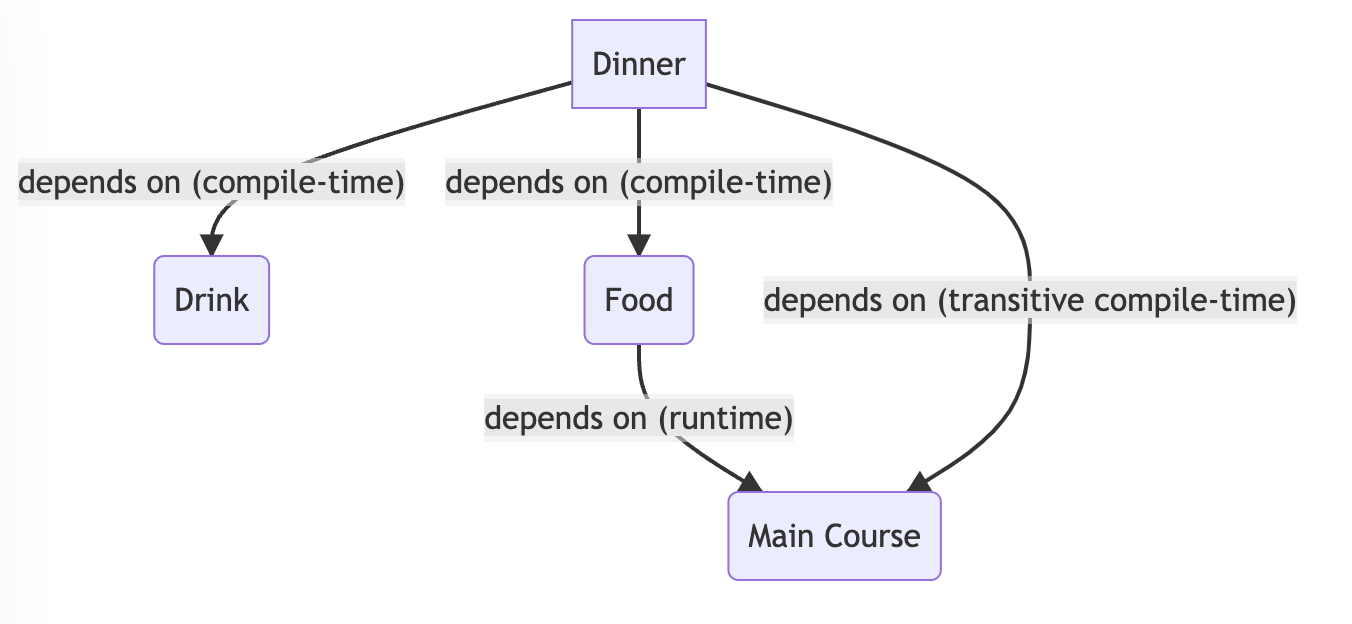
As you can imagine, the more compile-time or transitive compile-time dependencies a file has, the more likely it will need to be recompiled when other files change. If you have too many then even changing a single file can cause 10s or hundreds of other files to get recompiled, slowing you down.
The plot thickens — circular dependencies
Now imagine we wrote some code like this in our MainCourse module:
defmodule MainCourse do
  def make, do: Dinner.microwave("pot noodle")
end
Now MainCourse has a runtime dependency on Dinner and we’ve created a circular dependency. This is bad!
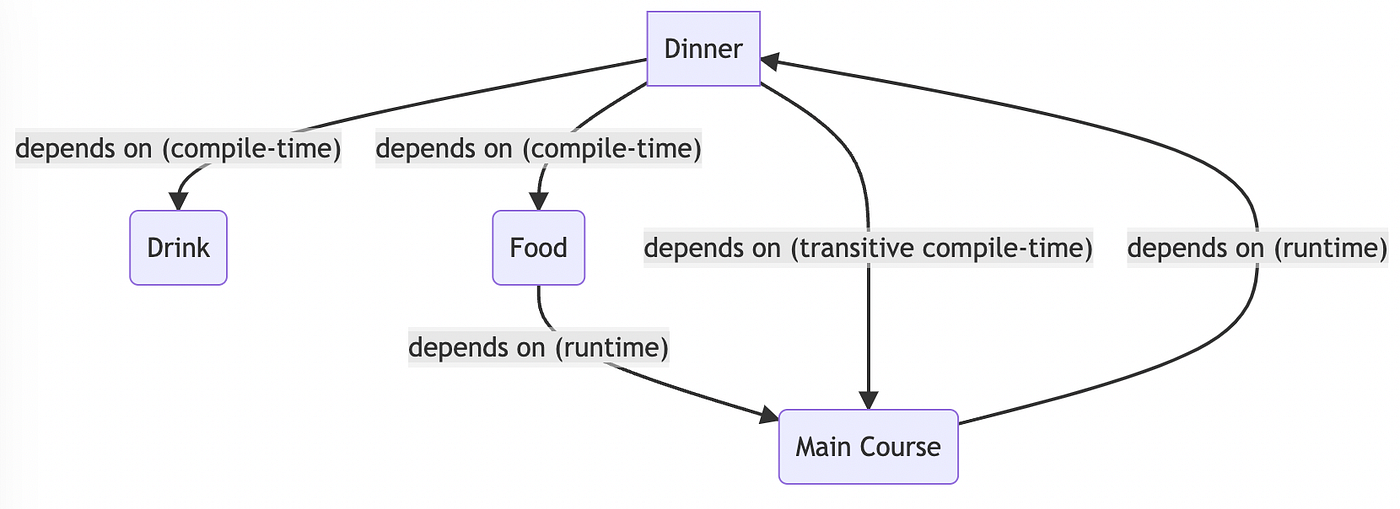
What it means is that every file in the loop has a runtime dependency on every other file in the loop, massively increasing the chances of transitive compile-time dependencies.
In the example diagram below you can see there is a runtime dependency cycle between A -> B -> C -> D -> E -> A -> ...etc
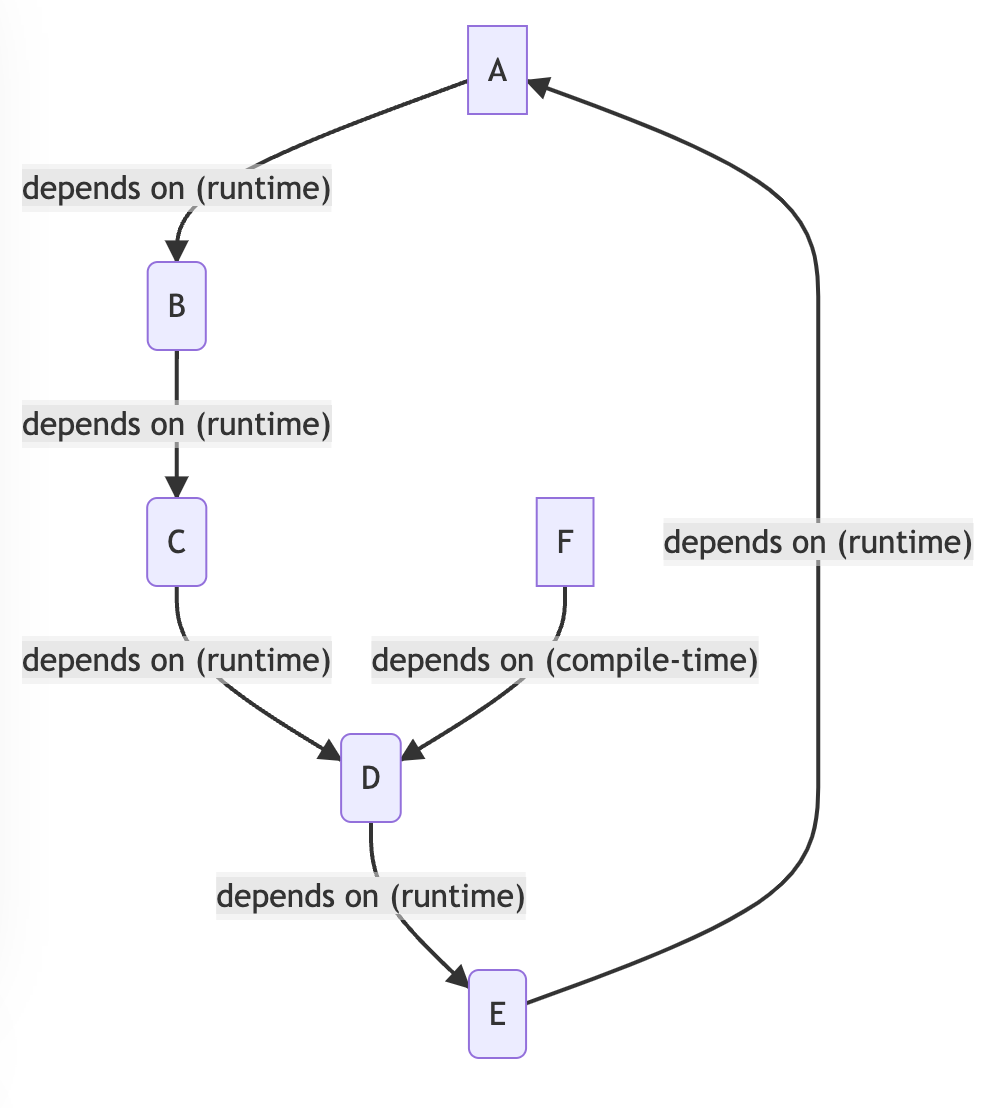
F has a compile time dependency on D, but because of the dependency cycle it means F also has a transitive compile-time dependency on A, B, C, and E! Now whenever any of those files change, F would also need to be recompiled.
In our example it actually doesn’t have an impact because Dinner already had a transitive compile-time dependency on the other files. But imagine if the loop were 100 files long. Now any file that has a compile-time dependency on any of those files will also have a transitive compile-time dependency on the other 99 files. Overall it increases the number of files needing to be recompiled with each change, which is bad news for your incremental compile times.
How do I know what type my dependencies are?
There are actually 3 types of dependencies:
- Compile-time, which happen in 2 main cases:
- When writing any code in the module body — i.e. outside of a function, like our example with module attributes
- When using Macros
- Run-time, which happen for any usual function calls
- Export dependencies — these are compile-time dependencies, but re-compilation is only needed for them when the module API changes (i.e. function args/arities change or a struct definition changes). They occur when you reference a struct from another module, or
importthe module
What next?
In the next 2 articles we’ll go through examples to help test your understanding, before finally sharing strategies to help improve compile times.